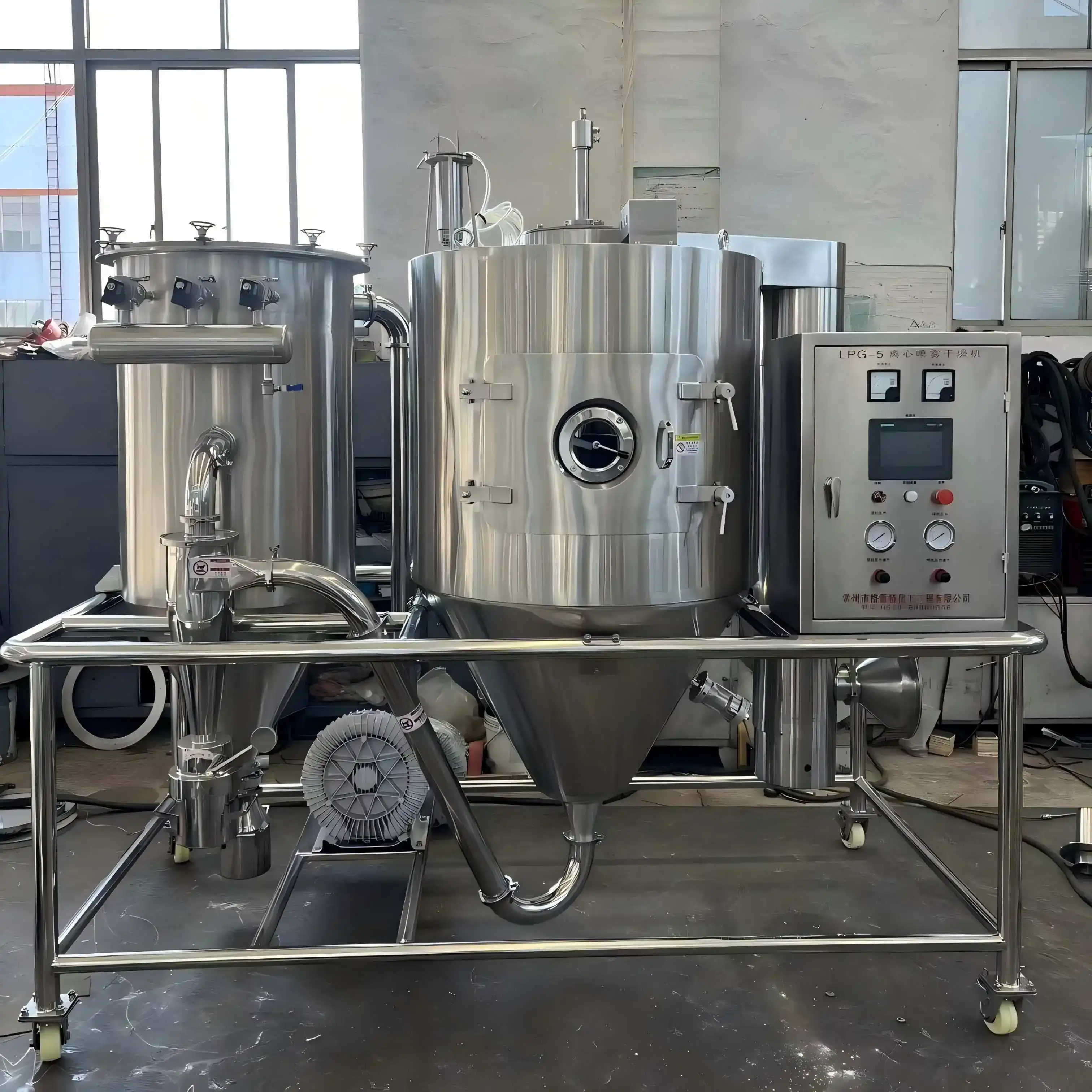
In the rapidly evolving landscape of chemical and pharmaceutical research, Laboratory Spray Dryer technology stands as a cornerstone for transforming liquid materials into high-quality powders with exceptional precision. These sophisticated instruments enable researchers and manufacturers to convert solutions, emulsions, suspensions, and pastes into consistent powder formulations through controlled atomization and drying processes. The growing demand for standardized pharmaceutical compounds and specialized chemical materials has made spray drying technology indispensable for achieving reproducible results while minimizing material waste and optimizing production efficiency.
Understanding Laboratory Spray Drying: Principles and Process
The essential rule of shower drying innovation revolves around changing fluid nourish materials into fine beads through atomization, followed by quick moisture expulsion in a controlled, warm environment. This advanced handle starts when fluid fabric enters the nourish pump framework, guaranteeing reliable stream rates throughout the operation.
Core Components and Their Functions
Modern shower drying frameworks comprise a few basic components working in agreement. The high-efficiency atomizer, regularly highlighting unique imported spout innovation, makes uniform bead dispersion basic for reliable molecule arrangement. The discuss warming framework keeps up exact temperature control, whereas the compact drying chamber gives ideal home time for total moisture removal. The recuperation framework guarantees total powder collection with negligible item loss.
Critical Process Parameters
Understanding the Laboratory Spray Dryer altogether impacts last item quality. Gulf and outlet temperatures straightforwardly impact moisture content and warm push on heat-sensitive materials. Nourish stream rate influences home time and drying productivity, whereas atomization weight decides molecule measure dissemination. These parameters require cautious optimization, especially when dealing with pharmaceutical compounds that may debase beneath intemperate warm exposure.
Applications and Benefits of Laboratory Spray Dryers in Pharma and Chemical Sectors
The flexibility of splash drying innovation expands over different businesses, with pharmaceutical and chemical segments speaking to the most demanding applications. These frameworks exceed expectations in making progressed sedate conveyance frameworks, typifying dynamic pharmaceutical ingredients, and creating potent chemical details with exact specifications.
Pharmaceutical Research Applications
In pharmaceutical advancement, shower dryers handle complex details counting proteins, hormones, anti-microbials, and chemicals, while maintaining their organic action. The innovation is important for creating controlled-release definitions and making strides medicate bioavailability through molecular optimization. Investigate and educate like Tsinghua College and Peking College have broadly utilized these frameworks for breakthrough pharmaceutical research.
Chemical Industry Applications
Chemical producers use splash drying for creating manufactured gums, colors, surfactants, and claim-to-fame catalysts. The innovation empowers exact control over powder characteristics, guaranteeing steady quality for downstream applications. Fabric science applications incorporate preparing ceramics, metal powders, and photosensitive compounds, where molecular consistency specifically impacts performance.
Quantifiable Benefits
The points of interest of advanced shower drying frameworks expand beyond essential powder generation. Vitality effectiveness advancements of up to 30% compared to conventional drying strategies diminish operational costs altogether. Fabric squander decrease frequently surpasses 15% due to moved forward recuperation frameworks and exact control. The reproducibility accomplished through computerized parameter control guarantees batch-to-batch consistency basic for administrative compliance in pharmaceutical manufacturing.
Choosing the Right Laboratory Spray Dryer: Decision Factors and Market Overview
Selecting suitable splash drying gear requires cautious assessment of numerous components, counting preparing prerequisites, fabric characteristics, and operational limitations. The choice between laboratory-scale and mechanical frameworks depends on throughput necessities, adaptability needs, and available capital investment.
Laboratory vs. Industrial Scale Considerations
Laboratory splash dryers offer Laboratory Spray Dryer and adaptability for inquiry about applications, empowering quick parameter alterations and small-scale handling. These frameworks ordinarily handle flow rates from 0.5 to 10 liters per hour, making them perfect for definition advancement and pilot testing. Mechanical units give higher throughput but give up a few degrees of adaptability in parameter control and require larger group sizes.
Key Procurement Factors
Successful gear choice equates specialized capabilities against budget limitations and operational prerequisites. Consider computerization levels, with color LCD touch screen interfacing giving natural operation and real-time parameter checking. Security highlights include programmed shutdown assurance and self-cleaning needle test frameworks, which diminish operational dangers and maintenance requirements. Compact plans optimizing research facility space utilization, while keeping up full functionality to critical preferences for research facilities.
Maintenance, Troubleshooting, and Optimization for Longevity and Efficiency
Maintaining ideal shower dryer execution requires orderly upkeep approaches and proactive investigation techniques. Standard support hones straightforwardly affect hardware life span, product quality consistency, and operational efficiency.
Essential Maintenance Practices
Routine upkeep starts with customary cleaning conventions for all product-contact surfaces, especially the atomizer spout and drying chamber. Preventive substitution of wear components counting channels, seals, and spout components, anticipates unforeseen downtime. The self-maintenance highlights found in progressed frameworks, such as programmed spout cleaning with flexible needle frequency, altogether diminish manual intervention requirements.
Common Troubleshooting Issues
Operational challenges frequently stem from spout blockages, conflicting molecule estimate dispersion, or temperature control inconsistencies. Shrewd operation control frameworks exchanging between programmed and manual modes give adaptability for tending to these issues. One-button startup capabilities and programmed temperature-controlled enactment diminish administrator blunder potential whereas keeping up handle consistency.
Great Drying Engineering: Your Partner for Advanced Laboratory Spray Drying Solutions
Changzhou Great Drying Engineering Co., Ltd. brings over two decades of specialized experience in developing cutting-edge laboratory spray drying solutions for chemical and pharmaceutical applications. Our company combines deep technical expertise with innovative engineering to deliver equipment that meets the exacting standards of modern research and production environments.
Proven Track Record and Industry Recognition
Since 2002, Great has pioneered new energy raw material equipment development, earning recognition as a benchmark enterprise in lithium hexafluorophosphate production equipment manufacturing. Our 13000L double cone rotary drying equipment, exported to Japan, the United States, and South Korea, demonstrates our commitment to international quality standards. The company has received multiple government technology progress awards, reflecting our dedication to innovation and excellence.
Comprehensive Product Portfolio
Our laboratory spray dryers feature advanced specifications designed for optimal performance across diverse applications. The feed pump system ensures consistent material flow while the high-efficiency atomizer utilizes original imported nozzle technology for superior atomization quality. The air heating system provides precise temperature control essential for heat-sensitive pharmaceutical compounds. Our compact laboratory-friendly design maximizes functionality while minimizing space requirements, and the complete powder recovery system ensures minimal product loss.
Technical Excellence and Customer Support
Great's technical team combines solid professional knowledge with outstanding practical operation capabilities, supported by numerous patent certificates safeguarding product quality and after-sales service. We offer comprehensive installation assistance, technical support, and maintenance contracts tailored to each client's specific requirements. Our customer-centric approach focuses on collaborative equipment development, transforming customer ideas into practical solutions that improve production quality and efficiency.
Conclusion
Laboratory spray dryers represent essential technology for advancing chemical and pharmaceutical research while meeting increasingly stringent quality requirements. The selection of appropriate equipment requires careful consideration of technical specifications, application requirements, and long-term operational needs. Great Drying Engineering combines decades of experience with innovative technology to deliver spray drying solutions that enhance research capabilities and production efficiency. Our commitment to quality, technical excellence, and comprehensive customer support positions us as a trusted partner for organizations seeking reliable, high-performance laboratory spray drying equipment.
FAQ
Q: What are the main differences between a laboratory spray dryer and an industrial spray dryer?
A: Laboratory spray dryers typically process smaller volumes (0.5-10 L/h) with superior parameter control for research applications, while industrial units handle larger throughputs (50-10000 L/h) optimized for production scale. Laboratory systems offer greater flexibility for formulation development, whereas industrial systems prioritize efficiency and consistent high-volume output.
Q: How can I optimize spray drying parameters for heat-sensitive pharmaceutical compounds?
A: Optimization involves maintaining lower inlet temperatures (80-120°C), using higher feed rates to reduce residence time, and implementing precise outlet temperature control (60-80°C). Advanced systems with color LCDs enable real-time monitoring of critical parameters, including inlet temperature, outlet temperature, and atomization pressure for optimal results.
Q: What after-sales services should I expect when purchasing a laboratory spray dryer?
A: Comprehensive after-sales support includes installation assistance, operator training, maintenance contracts, and technical support for parameter optimization. Leading manufacturers provide warranty coverage, spare parts availability, and remote troubleshooting capabilities to ensure continuous operation and minimize downtime.
Partner with Great for Superior Laboratory Spray Dryer Solutions
Ready to advance your research capabilities with industry-leading spray drying technology? Great Drying Engineering delivers customized laboratory spray dryer solutions backed by over 20 years of specialized experience serving chemical and pharmaceutical industries. Our advanced equipment features precise temperature control, efficient atomization, and compact designs trusted by over 1,500 research institutions worldwide. Contact our technical experts to discuss your specific requirements and discover how our innovative spray drying technology can enhance your research outcomes. Reach out to our experienced team at [email protected] for comprehensive consultation and competitive pricing from a trusted Laboratory Spray Dryer manufacturer.
References
1. Masters, K. (2002). Spray Drying Handbook, 5th Edition. Longman Scientific & Technical Publications.
2. Patel, B.B., Patel, J.K., Chakraborty, S., and Shukla, D. (2015). Revealing facts behind spray-dried solid dispersion technology used for solubility enhancement. Saudi Pharmaceutical Journal, 23(4), 352-365.
3. Vehring, R. (2008). Pharmaceutical particle engineering via spray drying. Pharmaceutical Research, 25(5), 999-1022.
4. Cal, K. and Sollohub, K. (2010). Spray drying technique for pharmaceutical applications. Pharmaceutical Development and Technology, 15(1), 3-18.
5. Sosnik, A. and Seremeta, K.P. (2015). Advantages and challenges of the spray-drying technology for the production of pure drug particles and drug-loaded polymeric carriers. Advances in Colloid and Interface Science, 223, 40-54.
6. Broadhead, J., Rouan, S.K., and Rhodes, C.T. (1992). The spray drying of pharmaceuticals. Drug Development and Industrial Pharmacy, 18(11-12), 1169-1206.