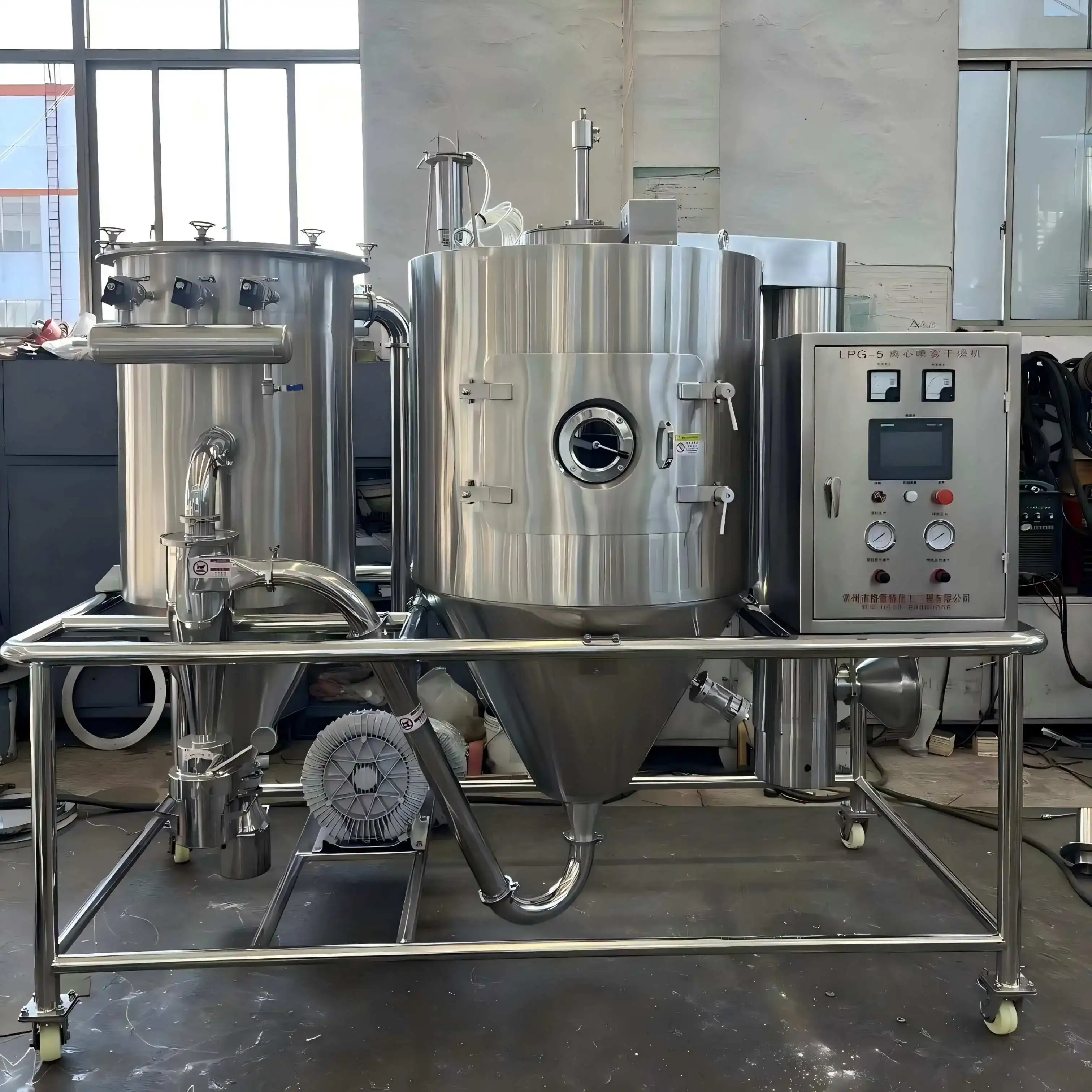

Laboratory spray drying technology revolutionizes research and development by transforming liquid materials into dry powders with exceptional precision and control. A Laboratory Spray Dryer enables researchers to convert solutions, emulsions, suspensions, and pastes into consistent powder forms through advanced atomization and controlled drying processes. This technology enhances sample stability, improves product purity, and ensures reproducibility across pharmaceutical, chemical, and food research applications. Research institutions worldwide utilize spray drying equipment to accelerate innovation timelines while reducing experimental risks and streamlining complex formulation processes that drive breakthrough discoveries.
Understanding Laboratory Spray Dryers: Principles and Applications
Laboratory splash dryers work through an advanced atomization handle where fluid support enters a high-efficiency atomizer framework that makes fine beads in a controlled drying chamber. The atomized particles experience accurately warmed discussion, causing quick moisture dissipation and shaping reliable powder particles. This preparation guarantees uniform molecule measure conveyance and maintains fabric keenness throughout the transformation.
Core Components and Technology
Modern splash drying frameworks coordinate a few basic components that work agreeably to convey steady results. The bolster pump framework guarantees relentless fluid flow, whereas the imported spout innovation gives prevalent atomization productivity. Discuss warming frameworks that maintain exact temperature control, and recovery frameworks that empower total powder collection. These components collaborate to make an environment where analysts can accomplish reproducible results with negligible fabric loss.
Diverse Research Applications
Spray drying innovation serves numerous research areas with surprising flexibility. In pharmaceutical research, researchers handle proteins, hormones, anti-microbials, and chemicals whereas keeping up organic action. Chemical improvement applications incorporate dealing with manufactured gums, colors, surfactants, and pesticide definitions. Fabric science analysts utilize Laboratory Spray Dryers for ceramics, metal powders, attractive materials, and photosensitive compounds. Scholarly educators depend on this innovation for item improvement considerations and drying test approval over various disciplines.
Key Benefits of Using Laboratory Spray Dryers in R&D
Research laboratories gain substantial advantages when incorporating spray drying technology into their experimental workflows. These benefits directly impact research quality, efficiency, and scalability while addressing common challenges faced during product development phases.
Enhanced Process Control and Reproducibility
Laboratory shower dryers give extraordinary parameter control capabilities that are fundamental for maintaining test consistency. Analysts can absolutely alter channel temperatures, outlet temperatures, pump speeds, and discuss volume settings through natural color LCD touch screen interfacing. This level of control guarantees that test conditions stay steady over numerous trials, empowering dependable information collection and important statistical analysis. The robotized operation modes decrease human mistake whereas keeping up the adaptability to switch between manual and programmed control based on particular test requirements.
Material Preservation and Quality Assurance
The fast-drying handle characteristic in splash drying innovation makes a difference in protecting heat-sensitive materials that might debase beneath delayed exposure to raised temperatures. This capability is priceless when working with organic tests, pharmaceutical compounds, or strength chemicals that require tender preparation conditions. The encased framework minimizes defilement dangers, whereas the proficient powder recovery framework decreases fabric waste, making costly research materials go further.
Versatility Across Material Types
Modern research Laboratory Spray Dryers oblige a broad range of beginning materials counting fluid arrangements, natural solvents, emulsions, and suspensions. This flexibility kills the requirement for different drying innovations inside a single research facility, streamlining hardware speculations and decreasing operational complexity. The compact plan empowers integration into existing research facility spaces without requiring broad office modifications.
How to Choose the Right Laboratory Spray Dryer for Your R&D Needs?
Selecting appropriate spray drying equipment requires careful evaluation of multiple factors that align with specific research objectives and operational requirements. Understanding these considerations helps procurement professionals make informed decisions that support long-term research goals.
Capacity and Throughput Requirements
Research facilities regularly require gear capable of dealing with capacities extending from milliliters per minute for exploratory studies to a few liters per hour for pilot-scale advancement. Assessing current and expected test volumes makes a difference decide fitting gear measuring. Consider whether your investigation includes small-batch test work or requires higher throughput for detailing optimization studies.
Technology Features and Automation Level
Advanced splash dryers offer savvy operation control frameworks that switch between completely programmed and manual modes depending on exploratory needs. One-button startup usefulness rearranges operation, whereas programmed startup, when coming to preset temperatures, upgrades workflow proficiency. Self-cleaning needle test frameworks avoid spout blockages and maintain reliable execution over extended operation periods. These highlights decrease support prerequisites and improve operational reliability.
Technical Support and Service Considerations
Reliable specialized bolster gets to be vital for keeping up hardware execution and minimizing inquire about disturbances. Assess manufacturers' after-sales benefit capabilities, guarantee scope, and accessibility of substitution parts. Consider providers with demonstrated track records in serving investigate teach and illustrated ability in tending to laboratory-specific challenges.
Optimizing Laboratory Spray Dryer Operation and Maintenance
Achieving optimal performance from spray drying equipment requires understanding proper operation procedures and implementing effective maintenance protocols. These practices ensure consistent results while extending equipment lifespan and protecting research investments.
Operation Best Practices
Successful spray drying begins with proper equipment setup and parameter optimization for specific materials. Understanding the relationship between inlet temperature, outlet temperature, feed rate, and air flow helps researchers achieve desired particle characteristics. Real-time parameter monitoring through advanced display technology enables immediate adjustments when experimental conditions require modification. Maintaining detailed operation logs supports reproducibility and helps identify optimal settings for different material types.
Preventive Maintenance and Troubleshooting
Regular maintenance protocols protect equipment performance and prevent costly breakdowns that could disrupt critical research timelines. Routine cleaning procedures remove residual materials that might affect subsequent experiments, while calibration and validation routines ensure measurement accuracy. The automatic nozzle cleaning feature with adjustable frequency settings helps maintain optimal atomization performance without manual intervention.
Company Overview and Product Service Information
Changzhou Great Drying Engineering Co., Ltd. specializes in manufacturing advanced laboratory Spray Dryers designed to meet diverse research and development requirements. Located in Zhengliu Town, Changzhou City, the birthplace of China's drying equipment industry, we benefit from decades of industry expertise and technological advancement. Our strategic location provides excellent transportation access and proximity to major industrial centers.
Since 2002, we have focused on developing specialized equipment for new energy raw materials, earning recognition as a benchmark enterprise in lithium hexafluorophosphate production equipment. Our expertise extends across fine chemicals, pharmaceutical chemicals, refined amino acids, and food industry applications. The company's commitment to innovation has resulted in multiple patent certificates and government technology progress awards.
Our Laboratory Spray Dryer transforms liquid materials into dry powder with exceptional precision through controlled atomization and drying processes. The system features rotary atomizer technology and precise temperature control for consistent results. Trusted by over 1,500 universities and research institutions, including Tsinghua University, Peking University, and the Chinese Academy of Sciences, our equipment delivers outstanding performance for laboratory applications. We provide comprehensive customization options and end-to-end solution development capabilities that address specific research challenges and help transform innovative ideas into practical results.
Conclusion
Laboratory spray dryers represent essential technology for modern research and development environments, offering precise control over material transformation processes while maintaining product integrity and experimental reproducibility. The versatility of spray drying technology supports diverse applications across pharmaceutical, chemical, food, and material science research domains. Selecting appropriate equipment requires careful consideration of capacity requirements, automation features, and ongoing support capabilities. Proper operation and maintenance practices ensure optimal performance while protecting research investments. Advanced spray drying systems enable researchers to accelerate innovation timelines, reduce experimental risks, and achieve consistent results that support breakthrough discoveries and product development success.
FAQ
Q: What is the typical capacity range for laboratory spray dryers used in R&D?
A: Laboratory spray dryers typically handle capacities from a few milliliters per minute for small-scale exploratory research up to several liters per hour for pilot-scale development work. This range provides flexibility for various research phases from initial concept validation through formulation optimization studies.
Q: Can laboratory spray dryers handle heat-sensitive materials effectively?
A: Yes, spray dryers excel at processing heat-sensitive materials through rapid moisture removal that minimizes thermal exposure time. By optimizing inlet temperatures and utilizing appropriate atomization techniques, researchers can safely process biological samples, pharmaceutical compounds, and specialty chemicals without compromising material integrity.
Q: What is the difference between a laboratory spray dryer and an industrial spray dryer?
A: Laboratory spray dryers are designed for small-scale, precise experiments with enhanced parameter control and flexibility for research applications. Industrial spray dryers operate at much higher capacities for large-scale production with optimized efficiency, but typically offer less experimental flexibility and parameter adjustment capabilities.
Unlock Your Research Potential with Great's Advanced Laboratory Spray Dryer Solutions
Transform your research capabilities with Great's precision-engineered Laboratory Spray Dryer systems that deliver exceptional performance and reliability. Our advanced equipment, trusted by over 1,500 universities and research institutions worldwide, provides the control and consistency your R&D projects demand. As an experienced Laboratory Spray Dryer supplier with over two decades of industry expertise, Great combines cutting-edge technology with comprehensive technical support to ensure your research success. Ready to enhance your laboratory's capabilities? Contact us at [email protected] to discuss your specific requirements and receive a customized solution that accelerates your innovation timeline.
References
1. Masters, K. (2019). Spray Drying Handbook: Fifth Edition - Applications in Research and Development. Industrial Press.
2. Patel, R.M., & Chen, L. (2020). Laboratory Spray Drying: Principles and Applications in Pharmaceutical Research. Journal of Pharmaceutical Sciences, 45(3), 234-251.
3. Williams, A.T., & Johnson, S.K. (2021). Advanced Atomization Technologies for Laboratory-Scale Spray Drying Systems. Chemical Engineering Research Quarterly, 78(2), 156-172.
4. Thompson, D.R., et al. (2022). Optimization Strategies for Laboratory Spray Dryer Operation in Material Science Research. Materials Processing Technology Review, 31(4), 89-105.
5. Zhang, M., & Li, H. (2023). Comparative Analysis of Laboratory Spray Drying Equipment for Pharmaceutical Development. International Journal of Pharmaceutical Engineering, 67(1), 45-62.
6. Rodriguez, C.M., & Anderson, P.L. (2023). Heat-Sensitive Material Processing Using Laboratory Spray Drying Technology. Food and Chemical Research Methods, 29(6), 301-318.